

The Three Big Problems With Your Next Steps (And How to Fix Them)
If you want to move deals forward quickly, one of the key skills you need to master is setting high-value next steps with your customers.
The problem? Most salespeople do it wrong. Sometimes the next steps we propose create too much friction and resistance. When we let customers drive the next steps, their suggestions are often low-value. And even once we set them, sometimes buyers ghost us or bail out.
But the rewards for those who can master the next step process is great!
Research from Gong shows the time and attention spent cultivating good next steps directly correlate with higher win rates. When sellers don’t spend enough time on this, close rates drop. And on first calls in particular, the more time you spend on next steps and ensuring your customers commit to them, the faster those deals move.
So let’s examine the three biggest problems with setting high-impact next steps and how to fix them.
The Three Big Problems with Next Steps
.
Problem #1: You Introduce Too Much Friction
Imagine you went on a good first date. Engaging conversation. Promising chemistry. Then at the end, your date turns to you and says, “This was great! How about next week, we get married and go to Vegas for our honeymoon?!?”
Sounds ridiculous, right? But salespeople do this all the time.
I once coached a rep who couldn’t figure out why prospects weren’t committing to his next steps. When I listened to recordings of his calls, the reason was clear. When customers showed mild interest in his solution, he closed with lines like: “So as a next step, I’d love to have a one-hour deep dive discovery call with you and your leadership team so I can ask a bunch of questions about your business and show you our solution.”
After a high-level intro call that’s like asking someone to get married.
Unfortunately, when it comes to next steps, salespeople often fall into the trap of asking customers to do things they’re not motivated to do yet. And when the resistance and friction are more powerful than their motivation, deals stall.
Think of it like a physics problem.
Your opportunity is like a boulder you’re pushing up a hill. There’s resistance from headwinds like status quo bias, objections, and risk. Your job is to boost the customer’s motivation to take the next step while making the ask itself easy to commit to.
Strike this balance and you move your opportunity forward. Don’t, and your deal will stall or die.

The Solution: Increase their motivation while reducing friction.
There are two solutions to this physics problem. First, you can overcome the friction by ensuring the thing you’re asking the customer to do represents clear value to them. And if you play it right, you’ll both increase their motivation to take the next step and deepen their appreciation for the problem they’re trying to solve.

A free review or assessment of the customer’s current state is a great place to start. HubSpot’s “Website Grader” tool is a great example of this. In exchange for your website and email, the tool will analyze your site’s performance and give you a report with actionable recommendations to improve visibility in Google search. The next step adds value, doesn’t over-commit the customer, and helps surface problems they didn’t already see.
The second is to warm the customer up with an interest-based call to action, followed by a reasonably sized (or “snackable”) but high-value next step.

For example, imagine you met someone at a party. You might be scared off if they said something like, “Hey, you seem really nice. Why don’t we go to dinner next Saturday at 7PM at this great Italian place in my neighborhood?” On the other hand, you’d likely be comfortable agreeing if they said something like “Hey, you seem really nice. Would you be interested in grabbing a coffee sometime?” Once they agree, they’re emotionally committed to the next step you proposed.
Sales research bears this out as well, with interest-based CTA’s showing double the conversion rate of specific CTA’s when it comes to generating meetings with cold leads.

So instead of saying: “As the next step, let’s meet next Thursday at 2 PM and I’ll take you through a detailed demo of our solution”, try, “This felt like a good conversation and it sounds like there could be some value here. Would you be interested in learning more about the connection between network security and revenue retention?” From there, you could continue with, “Great! Most customers find it helpful to schedule a 30-minute call to cover that. From there, you can decide how best to proceed. Sound good?” [Bonus: this “voice of the customer” approach works great when talking about your competition as well!]
Problem #2: Their Suggestions Are Bad
Sometimes we ask our customers to suggest a next step they feel makes sense. Psychologically, this can be a promising strategy because customers are always more committed to their suggestions than yours. The problem is, what if they make a bad suggestion like, “Send me some information and I’ll get back to you,” or “Send me a proposal,” or “Email me some pricing”?
At the very least, you’ve just lost control of your sales cycle. More likely, these sacrificial next steps were said in the interest of politeness, and the customer has no intention of moving forward, whether you fulfill them or not.
The Solution: Be prescriptive while giving customers agency.
I call this the 3 P’s of next steps.
1. Prepare: Go into every call with a curated list of possible next steps that can move your deal forward in a meaningful way. Perhaps it’s a secondary discovery call with key stakeholders, having the customer provide you with some information to allow you to do a follow-up analysis, or an interactive demo of your solution.
2. Propose: Suggest the best option. Don’t confuse your customer with too many choices. A single, well-calculated next step will serve both you and your customer best here.
3. Position: This nuance is very important. As I’ve discussed in the past, when customers feel cornered, a psychological principle known as reactance kicks in and they become extremely resistant. Instead, make them more receptive to the next step by positioning why it’s good for them and even giving them the option to say ‘no’ if they’re not aligned.
For example, “As a next step, our clients often find it helpful to take our 15-minute online self-assessment and then have a follow-up call with us to explore the results. From there, they’re in a better position to decide together whether or not to move forward. Do you think it makes sense to do that here? ” In this case, you’re not only providing social proof by referencing how similar clients evaluate your solution, but if they agree after being given the choice, they’ll be more committed to the next step (more on that tactic below).
Advanced Solution: Reframe their Suggestions
One of the best enterprise reps I ever worked with shared a powerful and counterintuitive approach to gain her customer’s commitment to next steps (and I have to admit, I use this a fair bit myself). First, she asked her customer what they thought a good next step would be. The beauty was that if the customer suggested something in the ballpark or better than what she had in mind, she’d go with their suggestion because they’d be more committed to it. But if they suggested something less ideal, too small, or unrealistic, she would gently reframe or pressure-test it without taking ownership away from them.
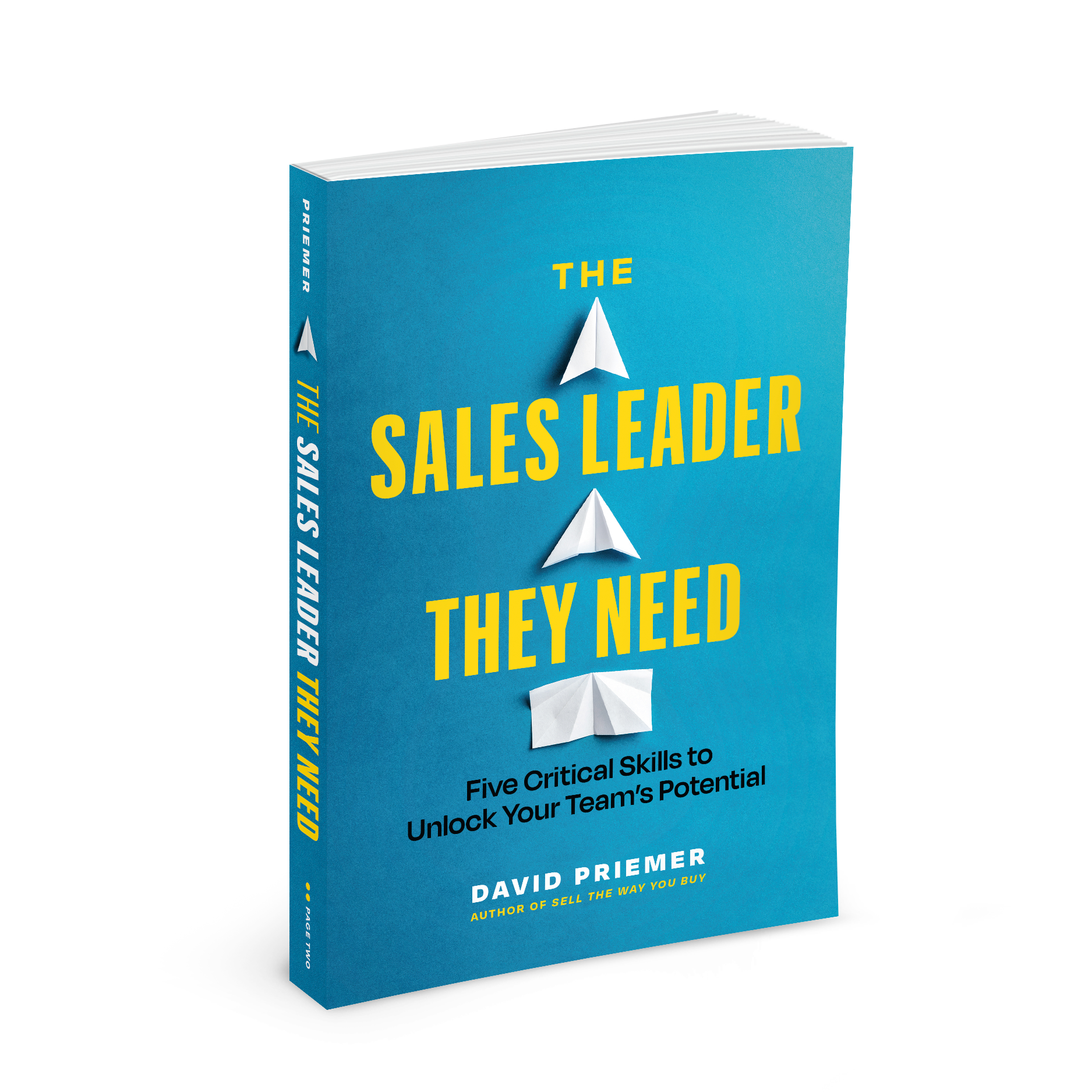
This is a powerful coaching tactic I talk about in The Sales Leader They Need, called the Kindergarten Class Rules approach; a nod to the way kindergarten teachers masterfully appear to let their young students set the rules of the class while maintaining control of the outcome through the power of suggestion and nudging.
So if you ask the customer what they think would be a good next step and they say, “Send me a proposal so I can discuss it with my manager,” you could reply with something like, “I can definitely send a proposal over. As a suggestion, because the managers we work with are often very busy and the proposal will be detailed, they often find it saves them a lot of time to have us walk them through it on a quick 15-minute call. That way, you’ll be able to have a more productive internal conversation afterward. Would it make sense to do that here?
This acknowledges their request, explains why it’s problematic, positively reframes the next step, and gives them permission to opt out.
And if they don’t agree to a reasonable, right-sized request, this might be a strong signal that the fit isn’t there. In this case, you should consider bowing out and losing faster to preserve your bandwidth.
Problem #3: Buyers Aren’t Committed
Even when you set what seems like a solid next step, customers back out, repeatedly reschedule, or no show.
Why? Because politely agreeing to something and being committed to it are two different things.
The Solution: Use questions to drive commitment.
The New York Times published an article entitled “In War Against No-Shows, Restaurants Get Tougher,” highlighting a famous Chicago restaurant that was losing $900,000 a year from customers who made reservations but never showed up.
The restaurant had been trying to reduce no-shows by making a simple request to patrons: “Please call us if you change your plans.”
The request was straightforward and polite. But even with it, the no-show rate was 30 percent. The solution? Change their request to a question: “Will you call us if you change your plans?”
With that small, subtle modification, no-show rates plummeted to 10 percent!
The reason for the incredible result has to do with a principle known as cognitive dissonance. The idea that humans feel psychologically compelled to align their actions with their stated beliefs and positions. In other words, when people publicly commit to doing something, they’re more likely to follow through.
So once you’ve agreed on the next step, you might say something like: “Great, let’s get this scheduled. I’m going to send you an invite. Quick question—if for whatever reason you can’t make this meeting or have second thoughts, will you reach out and let me know?”
Pause. Wait for their answer.
When they say yes, they’re now psychologically committed.
Advanced Solution: The Exception to “Does That Make Sense?”
Many people know I hate the phrase “Does that make sense?” because of the many ways it can be subconsciously misinterpreted.
But there’s one exception! Using it as a tactical proposition to drive commitment.
For example: “It sounds like the challenges you’re seeing in your business are aligned with the types of things we help customers with all the time. As a next step, do you think it would make sense for us to schedule a follow-up in a week or so, so we can do a deeper dive into our solution and see if there’s a fit? From there, you can decide whether it makes sense to continue the conversation.”
You’re not asking if they understand, you’re proposing a suggestion they can say yes or no to. When they say yes, they’re psychologically committed.
Not surprisingly, research shows that top salespeople use this suggestion-based language three times as often as low performers!
Putting It All Together
Setting next steps that actually win deals comes down to three things:
1. Reducing friction. Propose next steps that move the deal forward and deepen the customer’s pain without asking them to get married on the first date. Use interest-based calls to action when appropriate.
2. Being prescriptive when their suggestions are bad. Go in with a vision of what good next steps look like. When customers suggest something unproductive, acknowledge it and reframe it into something that actually moves the deal forward.
3. Driving commitment through questions. Get customers to publicly commit to next steps. Ask “Will you…?” instead of telling them “Please…” The psychological shift is powerful.
Remember: every next step you set is either moving your deal forward or letting it stall. The difference between winning and losing often comes down to those seemingly small moments at the end of calls.
Make them count!
PS – Did you find this approach helpful and want to learn more like it? Check out the popular Cerebral Selling Sales Academy training program!