

Stop Leading Your Pitch With “It Uses AI.” Do This Instead.
The first software product I ever sold had a killer differentiator.
It was web-based.
I know. Try to contain your excitement.
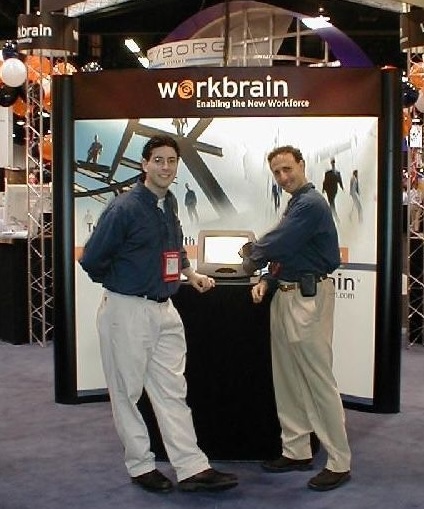
2001 Trade Show with CEO David Ossip (the height of men’s fashion meant enough khaki to upholster a sofa)
But back in 2000, this was genuinely a big deal. Software often required local installation. Deployments and upgrades were painful. In fact, I recall one deal where the cost of the software we sold was $1M, but the hardware it needed to run on cost the customer $5M!
So when we showed up at trade shows and announced that our software was entirely web-based, people paid attention.
Then came another exciting development: Cloud-based software.
Companies rushed to advertise that their solutions lived in the cloud. Modern! Innovative!
And for a while, it worked.
But imagine a salesperson walking into a customer meeting today and announcing, “Good news! Our software is web-based!”
Your customer would probably stare at you like you’re insane.
Which brings me to AI.
We’ve seen this movie before
Right now, seemingly every technology company is talking about selling AI. AI-powered platforms. AI-driven insights, and Agentic workflows.
And I get it. AI has absolutely transformed the game. The things it can do seemed like science fiction a few years ago. I also get that for many companies, demonstrating the traction and revenue associated with AI products is critical to driving their share price or valuation.
But just because a technology central to your business doesn’t mean leading with that technology is a compelling reason for a customer to buy your product.
AI has become the centrepiece of many companies’ messaging, the thing meant to make buyers pay attention.
Meanwhile, customers are getting closer to responding with a collective eye-roll and a, “Yes. Obviously. What else would it use?”
Because that’s what happens when technologies mature. First they’re revolutionary. Then they’re differentiators. Then they’re expected. Eventually, they become part of the plumbing.
Nobody buys software today because it’s web-based. They assume it is. And advertising that your product “uses AI” is heading in the same direction, fast.
So what should companies talk about instead? Here are three places I’d start.
1. Lead with the problem, not the product
One of the biggest challenges I see when working with sales organizations is confusing what makes a product impressive with what makes it valuable. I get it. When you’ve invested millions in a capability, you want to tell the world.
But suppose you had a horrible disease that I told you I had the cure for. You wouldn’t say, “Oh, but does it use AI? Because if it doesn’t, I’m not interested!”
In the same way, your customers don’t wake up thinking, “I really need to find a solution with more artificial intelligence in it.”
They’re thinking about mounting work, maddening inefficiencies, and disappointing results. Essentially, their attention is squarely fixated on the problem, which is why that’s what you should be leading with.
Compare these messages:
“Our AI-powered platform automates document processing using advanced machine learning.”
“Your team spends hours manually reviewing documents, correcting errors, and entering information into multiple systems. We can eliminate almost all of that work.”
Same underlying capability. Very different starting point. The second gives buyers a reason to care before appreciating the technology.
Customers don’t need you to convince them AI is exciting. They need to believe you understand the scope of their problems.
2. Make the value feel real, not just look good on paper
Even when companies move beyond technical features, they often fall back on generic benefits: save time, reduce costs, improve productivity. Or they build a spreadsheet showing an enormous projected return.
But here’s a key concept I’ve been jumping up and down about for years: Value and ROI are not the same thing! ROI is a calculation. Value is a feeling.
And that’s a huge distinction because the only thing that matters about your business case is whether y0ur customers feel the impact your solution provides.
Consider promising a 10% efficiency improvement. That might be mathematically accurate, but it doesn‘t create much of an emotional impact.
Now imagine explaining that the same improvement could prevent 10 employees from burning out and resigning every year, greenlight the development of the company’s next generation product, or give them a $50M boost to their valuation?
Suddenly the value feels more emotionally compelling.
And some of the most powerful value doesn’t appear in an ROI calculation at all. It’s the relief of knowing a critical process won’t fail. The confidence of walking into an executive meeting with answers instead of excuses. The peace of mind that comes from knowing your team isn’t drowning in preventable problems.
The objective isn’t to manufacture emotion or inflate the numbers. It’s to translate a credible improvement into something buyers can recognize, imagine, and believe.
3. Bring your customers a problem they didn’t know they had
Of course, speaking to a problem your customer already recognizes is a great way to earn their attention. But what if you could introduce them to a problem they didn’t even realize they had?
In my sales training, I call these Hidden Enemies. They’re the overlooked inefficiencies, risks, and missed opportunities customers have learned to live with, or may not even know exist.
And they’re especially powerful because you’re not just pitching a solution. You’re teaching customers something new about their world!
For example, rather than simply telling a customer your AI solution can automate their workflows, what if you could show them how an overlooked bottleneck in their existing process is quietly causing them to lose customers?
Or reveal how a seemingly harmless manual workaround is creating a risk they hadn’t considered?
Suddenly, you’re not another vendor promising greater productivity. You’re someone who’s helped them see their business differently.
And that creates something incredibly valuable: reciprocity.
When you teach customers something useful, they’re often more willing to give you something in return. Their attention. Their curiosity. Perhaps even the opportunity for a deeper conversation.
That’s the real power of leading with insight instead of technology.
And it’s why some of the most compelling sales pitches don’t begin by telling customers what your product can do. They begin by teaching customers something they didn’t know.
A quick test for sales leaders
Try removing every mention of AI from your sales presentation, website messaging, and product demo.
What’s left?
Can your team clearly explain the problem you solve, communicate its value in a believable and emotionally compelling way, and teach customers something new about a problem they may not even realize they have? If so, you’re in good shape. If the pitch falls apart without the AI references, you may have a positioning problem.
Technology will keep changing. But buyers will still want to eliminate frustrations, avoid losses, and solve problems that matter to them.
So keep building extraordinary technology. Just remember: your customers don’t ultimately care how impressive it is. They care about the problems it solves.